

Financial Statements for Non-Profit Organizations provide a clear view of financial position and activities, supporting board oversight, grant requirements, informed decision-making, and accurate preparation of Form 990 filings. Understanding Financial Statements for Non-Profit Organizations is crucial for transparency.
Whether you donate to a cause, volunteer your time, or serve on a non-profit board, you are investing in a mission you believe in. We see the public-facing work—the successful programs, the community outreach, the compelling stories. However, behind every impactful non-profit organization (NFP) is a complex financial engine. How can you be sure an organization is as effective and stable as its mission statement claims?
When evaluating a non-profit, reviewing its Financial Statements for Non-Profit Organizations can provide clarity on its operational effectiveness and financial stability.
When assessing any non-profit, reviewing its Financial Statements for Non-Profit Organizations can offer insights into its financial health and effectiveness in utilizing funds.
Moreover, Financial Statements for Non-Profit Organizations often reveal how resources are allocated, ensuring accountability to donors and stakeholders alike.
Effective governance of an NFP relies heavily on understanding its Financial Statements for Non-Profit Organizations and their implications.
The unique nature of Financial Statements for Non-Profit Organizations requires a specialized approach to auditing and oversight.
Moreover, Financial Statements for Non-Profit Organizations can reveal how funds are allocated and spent, providing accountability to stakeholders.
Understanding Financial Statements for Non-Profit Organizations is vital for assessing how effectively a non-profit fulfills its mission.
Understanding the nuances of Financial Statements for Non-Profit Organizations can empower board members in their oversight responsibilities.
The answer often lies in the financial statements, but these documents tell a much deeper and more surprising story than most people realize. They are more than just a collection of numbers; they are a narrative of an organization’s strategy, risks, and true impact. It’s a story of the tension between public perception and accounting reality, and understanding it is key to effective stewardship. This article reveals five impactful and often counterintuitive takeaways from the world of NFP accounting that can help you read between the lines.
By analyzing Financial Statements for Non-Profit Organizations, boards can better communicate their financial health to the public.
Thus, Financial Statements for Non-Profit Organizations can serve as a critical communication tool to stakeholders and potential donors.
The unique financial practices of NFPs as reflected in their Financial Statements for Non-Profit Organizations necessitate a tailored approach to auditing.
Furthermore, Financial Statements for Non-Profit Organizations can highlight the impact of community contributions and volunteer efforts.
Analyzing Financial Statements for Non-Profit Organizations can help in identifying areas of improvement and strategic focus.
Placement and clarity of Financial Statements for Non-Profit Organizations in reports can significantly influence donor perceptions.
Ultimately, the effectiveness of a non-profit can often be gauged through its Financial Statements for Non-Profit Organizations, influencing donor trust and investment.
It’s a common misconception that auditing is a one-size-fits-all process. However, the unique nature of non-profits requires a fundamentally different approach than the one used for commercial businesses. A standard commercial audit isn’t suitable for an NFP.
It has been said that you cannot fit a square peg into a round hole. The same principle applies to audits of NFPs. You cannot apply a standard commercial audit approach to the audit of an NFP and expect a good fit.
These Financial Statements for Non-Profit Organizations serve as a vital tool for transparency and accountability in the sector.
Understanding Financial Statements for Non-Profit Organizations enhances a non-profit’s ability to communicate effectively with its stakeholders.
The reason for this is rooted in the concept of accountability. A for-profit business is primarily accountable to its owners and shareholders, with a focus on profitability. In contrast, an NFP has public accountability. It is answerable to a governing board, but also to the public, and must demonstrate compliance with a complex web of laws, regulations, grant requirements, and other agreements. This distinction is crucial for an effective and efficient audit that is properly tailored to the NFP’s unique operational and regulatory environment.
In this context, Financial Statements for Non-Profit Organizations can also highlight the impact of community contributions.
These insights gleaned from Financial Statements for Non-Profit Organizations can drive better decision-making and strategic planning.
Analyst’s Takeaway: For a board member, this distinction is a matter of fiduciary duty. The annual audit is not merely a box-checking exercise to verify financial accuracy. It is a critical governance tool to validate the organization’s integrity against its specific obligations to the public, donors, and regulators. The board must ensure the audit engagement is scoped to address the NFP’s unique compliance risks, not just the numbers on the page.
When reviewed carefully, Financial Statements for Non-Profit Organizations can reveal key areas for improvement and focus.

The footnotes of a financial report are arguably the most overlooked section. They are often dense, technical, and relegated to the very end of the document. Yet, for a savvy non-profit, this section can be a significant branding and marketing tool, especially when it comes to disclosing contributed services.
Even when volunteer services don’t meet the strict criteria for financial recognition, they can—and should—be described in the notes. The difference in approach can be striking:
Crucially, placement matters. If a disclosure can impress potential donors and highlight the organization’s reach, it should not be “buried as footnote Z or 24 to the financial statements.”
The altruistic nature of the non-profit mission does not insulate these organizations from the pressures that can lead to fraudulent financial reporting. In fact, the pressure to demonstrate mission effectiveness creates its own unique set of incentives, often stemming from the desire to do good.
Key motivations for misrepresenting financial information can include:
This is impactful because it shows how the very metrics that donors and grantors use to judge an NFP’s effectiveness can create the pressure that leads to misrepresentation. It highlights the importance of robust governance and internal controls in safeguarding the organization’s integrity.
Analyst’s Takeaway: This highlights a critical governance challenge: the danger of a “win at all costs” culture, even when “winning” means securing a grant for a good cause. A board’s responsibility extends beyond reviewing financial reports; it must actively shape an environment where integrity is valued over perception. This means challenging management on how performance metrics are achieved and fostering a culture where transparency is paramount.
A comprehensive understanding of Financial Statements for Non-Profit Organizations is essential for achieving operational success.
In this regard, Financial Statements for Non-Profit Organizations can also play a role in improving stakeholder engagement.
Ultimately, Financial Statements for Non-Profit Organizations provide a framework for transparent reporting and accountability.
In conclusion, strategically leveraging Financial Statements for Non-Profit Organizations can enhance long-term viability and trust.
Many non-profits would cease to exist without their dedicated volunteers. This makes it all the more surprising that, in the world of accounting, most of this invaluable time cannot be financially recognized in the main statements. Only contributed services that meet particular criteria can be recorded as revenue.
For volunteer services to be recognized, they must meet one or more of the following strict criteria:
The insights derived from Financial Statements for Non-Profit Organizations can lead to more informed decisions and greater impact.
Specialized skills are defined as those provided by professionals such as accountants, carpenters, doctors, lawyers, and teachers. This means that the hours spent by a general volunteer stuffing envelopes or providing basic program support are not recorded financially. Furthermore, even if the NFP trains a volunteer, it doesn’t mean that person now possesses a specialized skill. For example, a volunteer trained by a non-profit to help adults learn to read does not possess the specialized skills of a professional reading teacher, so their time is not recognized as revenue.
This strict accounting definition is precisely what transforms the footnote disclosure mentioned earlier from a best practice into an essential strategic tool. It is the only place in an audited financial statement where an NFP can formally and powerfully communicate the true scale of the community engagement and donated labor that fuel its mission.
Analyst’s Takeaway: The rigidity of GAAP reporting on volunteer time presents a strategic imperative for the board. While the formal financial statements are constrained, the board’s understanding of the organization’s health must not be. A forward-thinking board should demand internal management reports that quantify the full operational value of all volunteer support. This complete picture is essential for making informed strategic decisions about resource allocation and demonstrating the organization’s true leverage of community assets.
Donors are often directed to websites that provide a simple ratio comparing an NFP’s program expenses to its supporting activities, such as management and fundraising. As a result, there is “tremendous pressure to have a high ratio of expenses in the program services category.” A high program ratio is seen as a sign of efficiency, while a high overhead ratio can be a red flag for potential donors.
The reality, however, is deceptively complex. Many of an NFP’s core expenses cannot be specifically identified with a single function. These “natural” expenses (so-called because they reflect the nature of the cost itself, like salaries or rent) support all aspects of the organization and must be reasonably allocated between program, management, and fundraising categories. This allocation process involves significant judgment and is based on methods that can vary between organizations.
Ultimately, maintaining clarity in Financial Statements for Non-Profit Organizations assists in achieving long-term sustainability.
Furthermore, NFPs often receive grants with specific limitations on what can be charged as an expense. These grant rules can conflict with Generally Accepted Accounting Principles (GAAP), creating an incentive for the organization to follow the grant’s reporting rules in its main financial statements instead of standard accounting practices. This highlights that a simple percentage rarely tells the whole story.
Effective management of resources as depicted in Financial Statements for Non-Profit Organizations is fundamental to mission success.
Understanding the allocation of funds in Financial Statements for Non-Profit Organizations prevents misinterpretations and enhances stakeholder confidence.
As such, Financial Statements for Non-Profit Organizations play a crucial role in funder relations and securing future support.
Analyst’s Takeaway: It is time for donors and board members to move beyond a simplistic reliance on the program-to-overhead ratio. A sophisticated stakeholder asks how expenses are allocated and understands that strategic investments in “overhead”—such as technology upgrades, talent development, and robust financial systems—are essential drivers of long-term mission impact, not signs of inefficiency. Judging an NFP on a single, often misleading, percentage ignores the very investments that enable sustainable success.
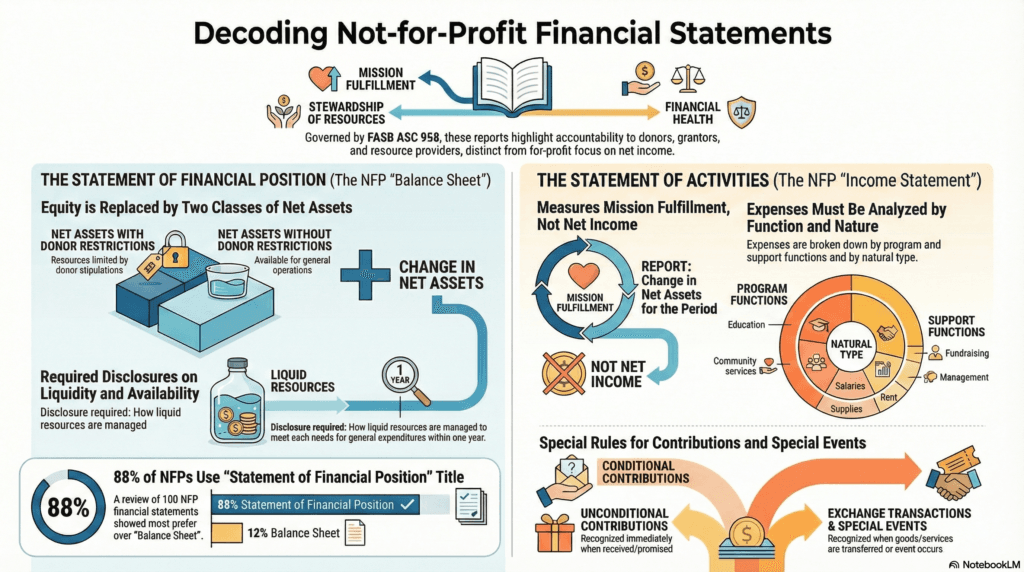
In conclusion, the essential role of Financial Statements for Non-Profit Organizations cannot be overstated in ensuring transparency and accountability.
From the specific lens of an audit to the strategic use of footnotes, these truths reveal a consistent theme: the metrics commonly used to judge a non-profit’s health often mask a more complex operational and financial reality. Understanding these surprising truths helps donors, board members, and staff move beyond surface-level metrics and become more informed, effective, and engaged stakeholders.