

Commonly referred to as a balance sheet, the statement of financial position is a financial selfie or snapshot of an organization’s financial health at a specific point in time.
The Nonprofit Statement of Financial Position gives stakeholders a clear view of the organization’s current financial resources.
By reviewing the Nonprofit Statement of Financial Position, nonprofits can identify strengths and weaknesses in their asset management.
Unlike other statements that show activities over a year, this report identifies the resources the nonprofit has available to fulfill its mission right now.
The fundamental accounting equation for this statement is: Assets = Liabilities + Net Assets

To provide meaningful information, nonprofits aggregate items with similar characteristics into homogeneous groups.
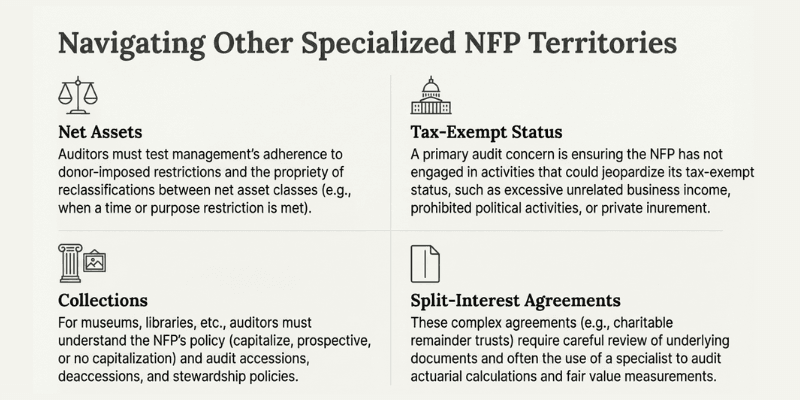
Because nonprofits lack traditional ownership interests like common stock, they report Net Assets (the residual interest after deducting liabilities).
The Nonprofit Statement of Financial Position is crucial for transparency and accountability in financial reporting.
Understanding the Nonprofit Statement of Financial Position helps to evaluate how well the organization can respond to financial challenges.
The classifications in the Nonprofit Statement of Financial Position provide insights into the financial health of the organization.
Under current standards (ASU No. 2016-14), these are divided into two classes:
Nonprofits use the Nonprofit Statement of Financial Position to determine available funds for upcoming projects.
The net assets reported in the Nonprofit Statement of Financial Position can help stakeholders assess financial sustainability.
The insights gained from the Nonprofit Statement of Financial Position guide decision-making for future funding.
Analyzing the Nonprofit Statement of Financial Position is essential for understanding cash flow needs.
A critical addition to the statement of financial position is the requirement to provide information about how the nonprofit manages its liquid resources to meet general expenditures within one year of the statement date.
The Nonprofit Statement of Financial Position is integral in measuring financial stability in uncertain times.
This statement is more than just a compliance tool; it is essential for strategic planning. Nonprofits use it to calculate key metrics:
Stakeholders reference the Nonprofit Statement of Financial Position to ensure the organization remains mission-focused.
In addition to these three core statements, current standards (ASU No. 2016-14) require all NFPs to provide an analysis of expenses by both their nature and function in a single location, which can be a separate statement, the notes, or the face of the statement of activities
Analogy for Understanding: Think of these three statements as a comprehensive medical report for a runner. The Statement of Financial Position is like an X-ray, showing the runner’s current bone and muscle structure (assets and debts) at one fixed moment. The Statement of Activities is the training log, recording the calories burned and nutrients gained (revenues and expenses) over the course of a month.
Finally, the Statement of Cash Flows is the heart rate monitor, tracking the literal pulse and movement of blood (cash) through the system to ensure the runner stays conscious and “liquid” enough to keep moving.
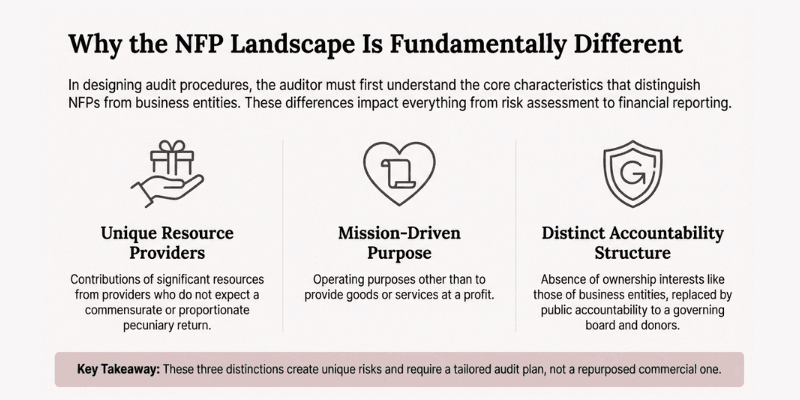
The primary difference between a not-for-profit (NFP) and a business entity lies in their fundamental operating purpose. While a business exists to provide goods or services at a profit to benefit its owners or shareholders, an NFP exists to achieve a specific mission or social purpose.
For effective planning, the Nonprofit Statement of Financial Position must be regularly updated and analyzed.
Reviewing the Nonprofit Statement of Financial Position helps to align financial resources with organizational goals.
The Nonprofit Statement of Financial Position serves as a foundation for financial audits and compliance checks.
Utilizing the Nonprofit Statement of Financial Position enhances reporting accuracy for regulatory bodies.
The key figures in the Nonprofit Statement of Financial Position attract potential donors and partners.
Unique to the NFP sector is the requirement to report expenses by function. This allows users to see exactly how much is spent on program services (the mission) versus supporting activities like management, general administration, and fundraising. Businesses typically focus on natural classifications (e.g., rent, salaries, cost of goods sold) without this mission-based breakdown.
Analogy for Understanding: Think of a Commercial Bookstore versus a Public Library. The Bookstore (Business) is focused on the sale; its success depends on selling books for more than they cost to make a profit for the owner. The Library (NFP) is focused on “literacy”—its success is measured by how many people it serves and how well it uses its budget (stewardship) to provide books to the community, regardless of whether it makes money on the transaction.
The distinction between donor-imposed conditions and donor-imposed restrictions is critical in not-for-profit (NFP) accounting because it determines when and how contribution revenue is recognized in the financial statements.
While both concepts involve donor stipulations, the primary difference lies in the point of entitlement.
A donor-imposed condition is a stipulation that represents a barrier that must be overcome before the NFP is legally entitled to the assets.
A donor-imposed restriction is a stipulation that specifies a use for a contributed asset that is narrower than the broad purpose of the NFP’s mission.
Incorporating insights from the Nonprofit Statement of Financial Position can improve funding strategies.
The Nonprofit Statement of Financial Position is pivotal for guiding financial conversations with stakeholders.
To foster transparency, it’s vital to present the Nonprofit Statement of Financial Position clearly and understandably.
Focus: Restrictions relate to how or when an NFP can use resources that it already owns.
Types of Restrictions:
Revenue Recognition: Revenue is recognized immediately in the period the contribution is received. It is reported as an increase in Net Assets with Donor Restrictions on the Statement of Activities.
| Feature | Donor-Imposed Condition | Donor-Imposed Restriction |
| Core Concept | A barrier to entitlement. | A limit on the use of assets. |
| Question Asked | Is the money ours yet? | How are we allowed to spend it? |
| Key Indicator | Barrier + Right of return/release. | Specific purpose or time period. |
| Recognition Timing | Only after the barrier is cleared. | Immediately upon receipt. |
| Balance Sheet Item | Refundable advance (Liability). | Net Assets with Donor Restrictions. |
Under modern standards (ASU No. 2018-08), after an NFP determines that a contribution is unconditional (no barriers remain), it must then evaluate if that contribution is restricted to determine the proper net asset classification
The Nonprofit Statement of Financial Position provides a comprehensive overview of fiscal health for potential funders.
Analogy for Understanding: Think of a donor-imposed condition as a job interview. You only get the paycheck (the asset) after you complete the tasks required to “clear the hurdle” of being hired. If you don’t do the job, you don’t get the money.
A donor-imposed restriction is like a gift card to a specific restaurant. The money is already yours—it’s sitting in your wallet—but the giver has restricted you so that you can only spend it on Italian food, rather than whatever you want. You own it now, but your options for using it are limited.
For a contribution to be considered conditional, current accounting standards (ASU No. 2018-08) require that the agreement contain both of the following two elements:
If either of these elements is missing, the contribution is considered unconditional and must be recognized as revenue immediately.
The sources identify several indicators that a barrier exists, including:
Comparing previous Nonprofit Statement of Financial Position reports can highlight trends in financial management.
The presence of these two elements significantly changes how an NFP reports the money. For conditional contributions, revenue is not recognized until the barrier is substantially met. If the NFP receives the cash before clearing the barrier, it must record the funds as a refundable advance liability on its statement of financial position.
Analogy for Understanding: Think of a conditional contribution like a rebate offer for a new appliance. To get the money, there is a barrier (you must mail in the specific serial number and a receipt within 30 days) and a right of release (if you don’t send the proof, the company is released from its obligation to pay you).
You don’t own that rebate money and shouldn’t count it in your budget until you’ve successfully cleared those hurdles.
Investors may assess the Nonprofit Statement of Financial Position to gauge long-term sustainability.
The Nonprofit Statement of Financial Position can play a crucial role in strategic planning discussions.